Lean: Machine Checked Mathematics and Software
A programming language and proof assistant for Mathematics and Software Verification.
B.K. Birla College, Kalyan
Science is increasingly interdisciplinary
-
Modern breakthroughs rarely stay inside one department.
-
Biology now depends on computation, statistics, and learning systems.
-
The most important tools often live between fields, not inside one.
Demis Hassabis: With knowledge of AI, neuroscience, and biology which he put together, he made AlphaFold, which helped earn the 2024 Nobel Prize in Chemistry.
When the problem spans fields, the language of trust should span fields too.
Mathematics, Computer Science and Today
Mathematics
Computer Science
AI
Lean
The power that Mathematics is in Theorems. So why not use it?
What Lean gives you
-
A programming language for computation.
-
An interactive theorem prover for proofs.
-
A shared environment where the same file can run code and verify claims.
-
#evalis a discovery tool too — compute examples first, then conjecture and prove.
def listSearch? (xs : List Nat) (y : Nat) : Nat :=
match xs with
| [] => 0
| x :: xs' => if x = y then 0 else 1 + listSearch? xs' y
-- The SAME file that runs this can prove a fact about it:
theorem listSearch?_head (xs : List Nat) (y : Nat) :
listSearch? (y :: xs) y = 0 := by
simp [listSearch?]
The core idea
-
Lean turns specifications into code that can be verified mathematically.
-
A proof of correctness is a guarantee that the code meets the specification.
Mindset Shift
From asking whether a program looks correct → Proving that it is correct.
"But who checks the checker?" — a small, human-auditable kernel does. Trust it once, and every proof it accepts is correct.
The proof assistant is the judge. If it tells you the proof is valid, you can trust the math.
Paradigms for Software Testing
Tests sample behavior. Proofs certify behavior.
-
Tests are finite; bugs live in infinite input spaces.
-
A passing test suite is evidence, not a guarantee.
-
Proofs force you to state the property for every input that matches the specification.
If the specification is wrong, tests may never notice. A proof attempt usually forces the mistake into the open.
A bug that tests can miss
def binarysearch(a, x):
  lo, hi = 0, len(a)
  while lo < hi:
    mid = (lo + hi) // 2
    if a[mid] < x:
      lo = mid    # bug: should be mid + 1
    else:
      hi = mid
  return lo
Most test inputs never land on the one case that breaks: hi - lo = 1.
A proof has to face it anyway.
The same bug, formalized
The bound update, distilled to just the arithmetic — same mistake, no array required:
def lowerUpdate (lo hi : Nat) : Nat :=
  (lo + hi) / 2          -- bug: same mistake as the Python
The range must shrink every step, or the search never ends. Let's ask Lean to check that:
theorem lowerUpdate_progress (lo hi : Nat) (_h : lo < hi) :
lo < lowerUpdate lo hi := by
unfold lowerUpdate
omega
lo = 0, hi = 1 breaks it: lowerUpdate 0 1 = 0, so lo < lowerUpdate lo hi is just false.
Lean refuses to fake a proof of a false statement — that refusal is the bug report.
...and fixed
One token — + 1 — is the entire fix:
def lowerUpdate' (lo hi : Nat) : Nat :=
  (lo + hi) / 2 + 1
theorem lowerUpdate_progress' (lo hi : Nat) (h : lo < hi) :
lo < lowerUpdate' lo hi := by
unfold lowerUpdate'
grind
Testing finds examples. Proving eliminates whole classes of failures.
Lean in the world
Lean is used by Mathematicians, Computer Scientists and today, even in industry, for Software Testing.
Lean matters because it scales from student proofs to serious verification work — and from a Fields Medalist's private worry to a first-year's homework.
When bugs are expensive, proofs are cheaper than incidents. When a proof is contested, Lean settles it.
Lean and Games
Lean Theorems are proved using tactics. These tactics are like moves in a game, and the proof is a winning strategy. Watch the goal change after every move:
theorem length_append : ∀ (xs ys : List Nat),
(xs ++ ys).length = xs.length + ys.length := by
intro xs ys
induction xs with
| nil => simp
| cons x xs ih =>
simp only [List.cons_append, List.length_cons]
omega
The ability to make a game out of a proof, turning mathematics into a game, is a powerful!
Who can play this game?
-
You
-
Your Pet. Why not??
-
AI. Lean is a referee that can check every step.
As long as you can write a tactic, know a little bit of math and coding, you can play this game. You can DO Mathematics in a way you have never done before.
AI in Lean
-
AI can learn to play the game of proving theorems in Lean.
-
The Lean checks each steps, tells AI if it is valid or not.
-
Now AI systems can prove mathematical and software correctness theorems, with Lean as the referee.
Autoformalization is the future of mathematics and software verification.
Vibe Proving
"Vibe coding" — let an AI write code you don't fully check — is fine until the bug is expensive. Vibe proving is the fix: let AI attempt the proof, and let Lean be the one that actually checks it.
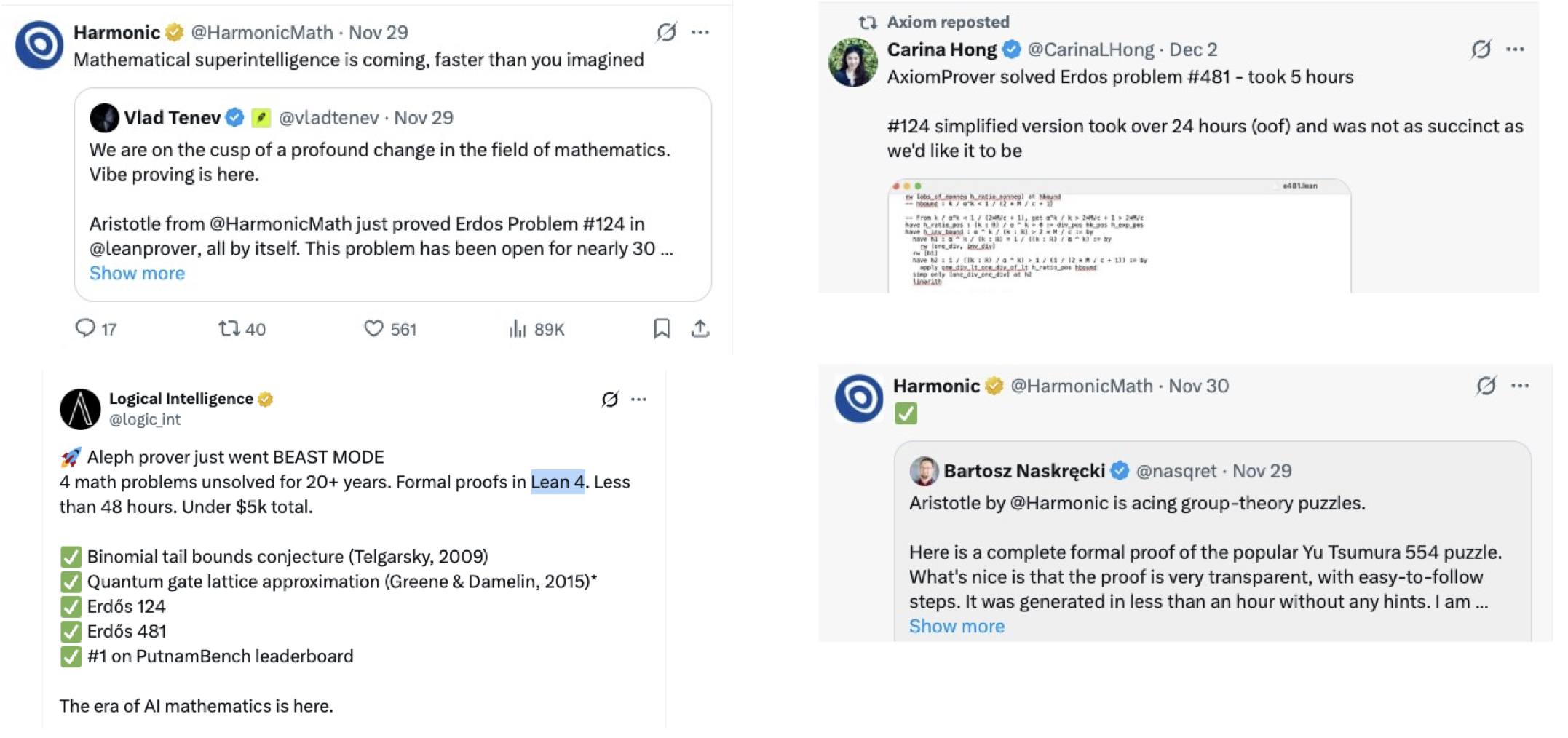
The AI can be wrong as often as it likes — Lean simply won't accept a broken proof.
Startups in Lean
This isn't just academic anymore — a new wave of companies is building products where Lean's verifier is the trust layer.
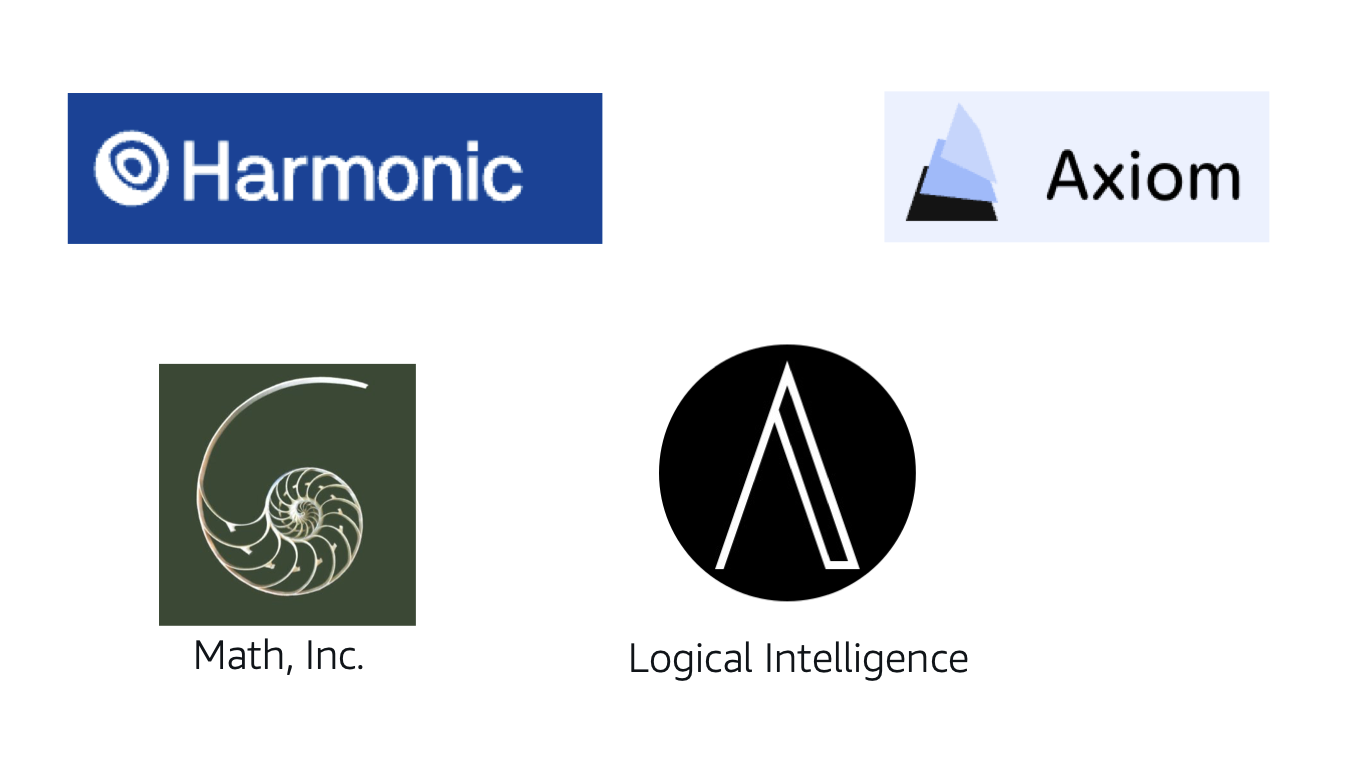
Lean Demo
Let's open the editor
Getting started
Everything is free and open:
-
Natural Number Game — prove theorems in your browser, no install.
-
Mathematics in Lean — the standard tutorial book.
-
live.lean-lang.org — try Lean online, Mathlib included.
-
The Lean Zulip chat — a famously welcoming community.
leanprover-community.github.io · adam.math.hhu.de/#/g/leanprover-community/nng4
Thank you
Questions?