PastaLean
Transpiling and Verifying Python in Lean 4 — without LLMs
20 October 2026
Overview
-
Why verify Python at all — and why in Lean
-
How PastaLean turns Python into Lean, node by node
-
What we support: control flow, classes, libraries…
-
Proving the generated code correct
What are we cooking?
 Pasta
+
Pasta
+
 Python
+
Python
+
 Lean 4
=
Lean 4
=
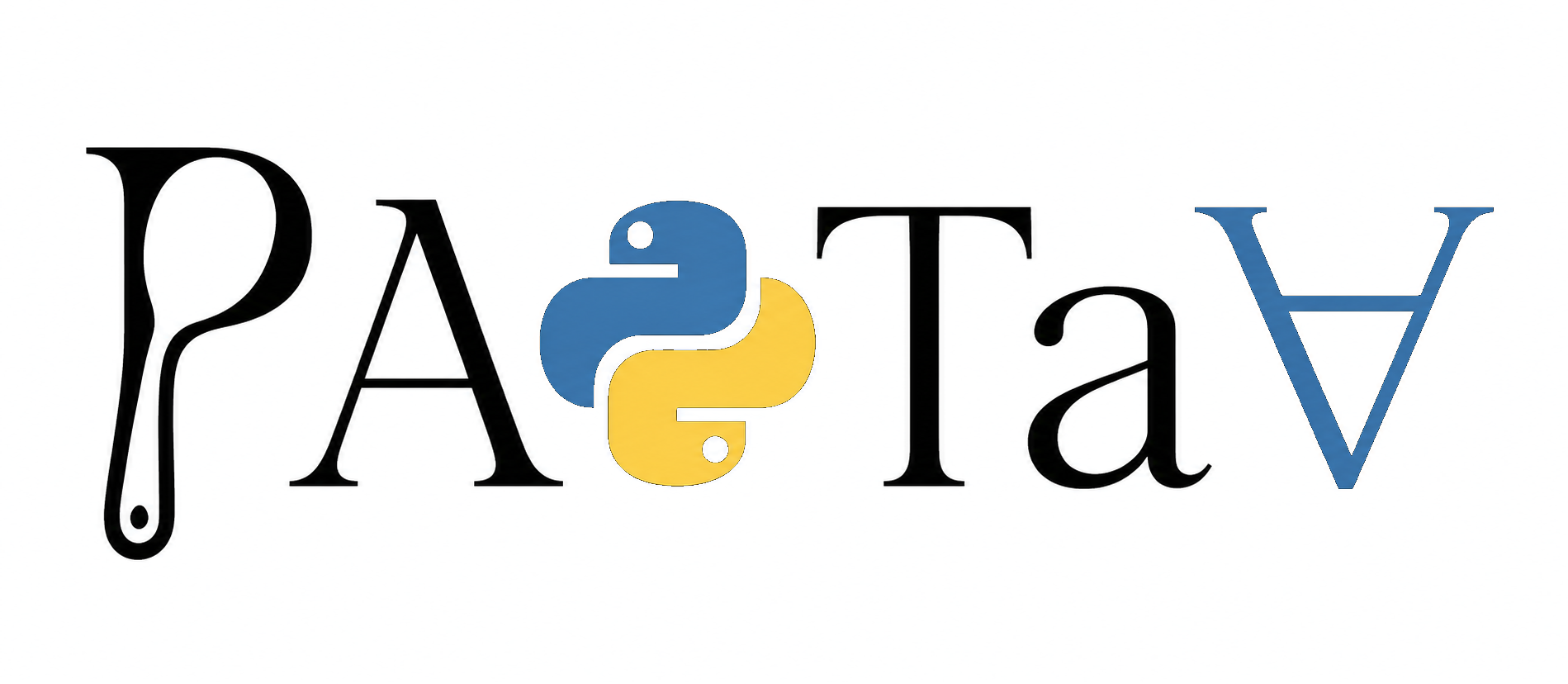
P·ast·aLean → PastaLean
How to eat(use) PastaLean?
-
Take ordinary, logical Python — the kind data scientists and practical logical code's LLMs actually write.
-
Preprocess Python code for Type annotations, obtain it's Abstract Syntax Tree(AST) and give Lean it's JSON format.
-
Transpile it into Lean 4 — deterministically, with no LLM, so the meaning never drifts.
-
Prove it correct — and let Lean's proof automation do the heavy lifting with a little help by LLM's.
The Goal: write in Python, get the guarantees of a proof assistant.
What is the Inspiration for this dish?
-
Two things dominate how code gets written today: Python (the language) and LLMs (increasingly, the author).
-
A huge and growing share of the Python running in the world was drafted by an LLM.
-
But here's the uncomfortable question:
Who checks that the generated code is actually correct?
-
Tests only catch the bugs you thought to write — never the ones you didn't.
-
To prove correctness (not merely test it), we reach for formal methods: Hoare logic, model checking, multi-modal verification…
-
Proof assistants make that practical — and there are several: Lean 4, Rocq (Coq), Isabelle, Dafny, …
-
We use Lean 4: a proof assistant that is also a fast, real programming language.
Why Lean?
Lean 4 is a proof assistant and a general-purpose language (it compiles to C — genuinely fast).
-
Powerful automation — tactics like
simp,grind,aesop, etc. search proofs and close goals for you, often in one line. -
Endlessly customizable — custom syntax, macros, and tactics let you extend the language itself — exactly how PastaLean is built.
-
Trusted where it matters — used by Fields medallist Terence Tao, backed by the Lean FRO, applied to industrial verification.
-
A small, auditable kernel re-checks every proof — nothing is taken on faith.
See Leo de Moura's blog Why Lean?.
Why convert Python into Lean?
-
Blindly trusting an LLM's Python means shipping logic no one has proved — silent wrong answers, bad edge cases, security holes.
PastaLean gives that code a home where the compiler is the reviewer:
-
if it type-checks against our runtime, the translation is faithful;
-
if the proof closes, the logic is correct.
Write it in Python. Trust it like Lean.
And because pure Python becomes bare Lean terms, we can state and prove theorems about it.
Why transpile — and not just ask an LLM?
The obvious shortcut: "LLM, translate this Python to Lean." We deliberately do not do that for the core translation. LLMs earn their keep elsewhere — proposing contracts — never as the translator.
Prompt an LLM to translate | PastaLean (AST transpiler) |
|---|---|
Hallucinates; silently changes semantics | Deterministic — same node, same Lean, always |
Not reproducible, not auditable | One runtime pins what each operation means |
Breaks on long / scaled programs | Compositional: per-statement, streamed |
No ground truth that it is correct | Output is checked by the Lean elaborator |
Other Possible methods maybe?
-
Other Methods like using FFI is possible, however theorem proving would not be possible.
-
Converting Lean to Python is possible, however legacy python checking would not be possible and there are a lot more python programmers.
How does PastaLean taste code?
It reads Python's AST and emits Lean you can prove:
def sum_to_n(n: int) -> int:
    Requires(n >= 0)
    total = 0
    for i in range(n + 1):
        Invariant(2*total == i*(i - 1))
        total = total + i
    Ensures(2*total == n*(n + 1))
    return total
↓ ast-parse
FunctionDef(name='sum_to_n',
  args=[arg('n', Name('int'))],
  body=[
    Expr(Call(Requires,
      Compare(Name'n', GtE, 0))),
    AnnAssign('total', Name'int', 0),
    For('i', Call(range, …), body=[
      Expr(Call(Invariant, …)),
      Assign('total', BinOp(…, Add, …))]),
    Expr(Call(Ensures, …)),
    Return(Name'total')])
→ transpile
def sum_to_n := fun (n : Int) ↦
  (do
    let mut total := (0 : Int)
    for i in (PastaLean.pyRange (n +ₚ (1 : Int)))do
      let _ := Libraries.passta.pyPassInvariant ((2 : Int) *ₚ total == i *ₚ (i -ₚ (1 : Int)))
      total := total +ₚ i
    let _ := Libraries.passta.pyPassEnsures ((2 : Int) *ₚ total == n *ₚ (n +ₚ (1 : Int)))
    return total : Id _)
↓ prove — automatically
theorem sum_to_n_spec : ⦃⌜n ≥ (0 : Int)⌝⦄ sum_to_n n ⦃⇓_ => ⌜True⌝⦄ :=
by
mvcgen [sum_to_n, PastaLean.pyRange_forIn, PastaLean.pyRange_forIn_start] invariants
· ⇓⟨cur, total⟩ =>
⌜let i := (cur.prefix.length : Int);
(2 : Int) *ₚ total = i *ₚ (i -ₚ (1 : Int))⌝
simp_all [taste_ingr]; grind +locals +suggestions
#eval sum_to_n 10
Two Functions for each code
PastaLean converts each function in Python into 2 functions each with it's own purpose:
-
Provable - This function is meant to be used for property proving of the function.
-
Computable - This function is meant to be computable with
#eval. These are marked with'rnin function name, which stands forrun.
Difference | Provable | Computable |
|---|---|---|
Python |
Converted to |
Lean's inbuilt |
Provable | Yes | Sometimes depending on function, not always. |
Computable | Sometimes. If ℝ is used then never. | Yes |
API differences( | Special non-IO Monad based functions are used to support proving. | IO Monad functions are used for real behaviour. |
Example of Provable/Computable Function
One Python function forks into two Lean definitions:
def euclidean_distance(p1, p2):
    if len(p1) != len(p2):
        raise ValueError("Points must have the same number of dimensions")

    # Using zip, list comprehension, and math.pow
    sq_diffs = [math.pow(a - b, 2) for a, b in zip(p1, p2)]
    return math.sqrt(sum(sq_diffs))
↙ provable
noncomputable def euclidean_distance := fun (p1 : List Int) ↦ fun (p2 : List Int) ↦
  ((do
      if h_1 : PastaLean.pyLen p1 ≠ PastaLean.pyLen p2 then
        throw
            (PastaLean.PyException.Raise "ValueError"
              (ToString.toString "Points must have the same number of dimensions"))
      else
        let _ := ()
      -- Using zip, list comprehension, and math.pow
      let mut sq_diffs :=
        (PastaLean.pyIter (PastaLean.pyZip p1 p2)).map fun _pair_1 =>
          let a := Prod.fst _pair_1;
          let b := Prod.snd _pair_1;
          Libraries.math.pyMathPowExact (a -ₚ b) (2 : Int)
      let __py_ret_1 := Libraries.math.pyMathSqrtR (PastaLean.pySum sq_diffs)
      return __py_ret_1) :
    PastaLean.PyExceptId _)
↘ computable
def euclidean_distance'rn : List Int → List Int → PastaLean.PyExcept Float := fun (p1 : List Int) ↦
  fun (p2 : List Int) ↦ do
  if h_1 : PastaLean.pyLen p1 != PastaLean.pyLen p2 then
    throw
        (PastaLean.PyException.Raise "ValueError" (ToString.toString "Points must have the same number of dimensions"))
  else
    let _ := ()
  -- Using zip, list comprehension, and math.pow
  let mut sq_diffs :=
    (PastaLean.pyIter (PastaLean.pyZip p1 p2)).map fun _pair_1 =>
      let a := Prod.fst _pair_1;
      let b := Prod.snd _pair_1;
      Libraries.math.pyMathPow (a -ₚ b) (2 : Int)
  let __py_ret_1 := Libraries.math.pyMathSqrt (PastaLean.pySum sq_diffs)
  return __py_ret_1
How much Python is convertable?
Most everyday Python is convertable into Lean4. Extending new Python syntax is made very trivial with the help of our underlying design architecture.
Area | Python constructs handled |
|---|---|
Control flow |
|
Functions |
|
Data structures |
|
Comprehensions | list / dict / set / generator comprehensions |
Exceptions |
|
OOP |
|
Strings & misc |
f-strings, |
and more... ↓ press down to see the constructs by area, with examples.
Control flow
Branches & recursion
def fibonacci(n: int):
    if n <= 0:
        return 0
    elif n == 1:
        return 1
    else:
        return fibonacci(n - 1) + fibonacci(n - 2)
→
partial def fibonacci : Int → Int := fun (n : Int) ↦
  if decide (n ≤ (0 : Int)) then (0 : Int)
  else if n == (1 : Int) then (1 : Int)
  else fibonacci (n -ₚ (1 : Int)) +ₚ fibonacci (n -ₚ (2 : Int))
Loops & mutation → an Id.run do block:
def classify(nums: list[int]):
    total = 0
    for n in nums:
        if n % 2 == 0:
            total += n
        else:
            total -= n
    return total
→
def classify := fun (nums : List Int) ↦
  Id.run
    (do
      let mut total := (0 : Int)
      for n in (PastaLean.pyIter nums)do
        if h_1 : n %ₚ (2 : Int) = (0 : Int) then
          total := total +ₚ n
        else
          total := total -ₚ n
      return total)
Statements outside functions(in open) are also well supported.
Data structures & comprehensions
list · dict · set · tuple, slicing, indexing, container methods:
Comprehensions → map / filter
squares = [x*x for x in range(10)
               if x % 2 == 0]

cubes = {n: n**3 for n in range(5)}

evens = {x for x in range(10)
             if x % 2 == 0}
→
def squares :=
  (List.filter (fun x => x %ₚ (2 : Int) == (0 : Int))
    (PastaLean.pyRange (10 : Int))).map fun x => x *ₚ x

def cubes :=
  Std.HashMap.ofList
    ((PastaLean.pyRange (5 : Int)).map fun n => (n, n ^ₚ (3 : Int)))

def evens :=
  PastaLean.pySetFromList
    ((List.filter (fun x => x %ₚ (2 : Int) == (0 : Int))
      (PastaLean.pyRange (10 : Int))).map fun x => x)
List & string ops
nums = [3, 1, 2, 4]
head = nums[0]         # index
tail = nums[1:]        # slice
size = len(nums)

s = "hello world"
words = s.split(" ")
loud = s.upper()
→
def nums := [(3 : Int), (1 : Int), (2 : Int), (4 : Int)]
def head := nums⦋(0 : Int)⦌
def tail := PastaLean.pySlice nums (some (1 : Int)) none none
def size := PastaLean.pyLen nums

def s := "hello world"
def words := PastaLean.pyStringSplit s " "
def loud := PastaLean.pyStringUpper s
x[i] → pyGetItem, slicing → pySlice, iter → pyIter
Exception handling
try / except / finally, raise, typed except ValueError as e — one function, two twins:
def divide_add(a, b, c):
    try:
        result = a / b
        while result < c:
            result += 1
        return result
    except ZeroDivisionError:
        return "Division by zero error"
    finally:
        print("PastaLean handles exceptions gracefully.")
↙ provable
def divide_add := fun a ↦ fun b ↦ fun c ↦
  ((do
      try
        let mut result := a /ₚ b
        while (result < c) do
          result := result +ₚ (1 : Int)
        return result
      catch caught =>
        if (caught).OfKind == "ZeroDivisionError" then
          let _ ← pyPrintNoop [pyPrintArg "Division by zero error"]
          let __py_ret_1 := -(1 : Int)
          return __py_ret_1
        else
          throw caught
      finally
        do
          let _ ← pyPrintNoop [pyPrintArg "PastaLean handles exceptions gracefully."]) :
    PastaLean.PyExceptId _)
↘ computable
def divide_add'rn := fun a ↦ fun b ↦ fun c ↦
  ((do
      try
        let mut result := a /ₚ b
        while (result < c) do
          result := result +ₚ (1 : Int)
        return result
      catch caught =>
        if (caught).OfKind == "ZeroDivisionError" then
          let _ ← pyPrintIO [pyPrintArg "Division by zero error"]
          let __py_ret_1 := -(1 : Int)
          return __py_ret_1
        else
          throw caught
      finally
        do
          let _ ← pyPrintIO [pyPrintArg "PastaLean handles exceptions gracefully."]) :
    PastaLean.PyExcept _)
PyExceptId (pure, provable) vs PyExcept = ExceptT PyException IO (real IO).
Classes / OOP
A Python class becomes a Lean structure plus namespaced method definitions. self
is the structure value, and mutation is value-semantics (C.new builds one):
class Point:
    def __init__(self, x, y):
        self.x = x
        self.y = y

    def norm_sq(self):
        return self.x*self.x \
             + self.y*self.y

obj = Point(1,2)
norm = obj.norm_sq()
structure Point where
  x : Int
  y : Int
  deriving Inhabited, Repr, BEq

def Point.new := fun x ↦ fun y ↦ ({ x := x, y := y } : Point)
def Point.norm_sq := fun (self : Point) ↦ self.x *ₚ self.x +ₚ self.y *ₚ self.y

def obj := Point.new (1 : Int) (2 : Int)
def norm := Point.norm_sq obj
#check obj
#eval norm
Libraries
Implementing Library and integrating it in PastaLean is very trivial.
-
All you do is write the Lean function for your Python implementation, use our builtin typeclasses support if needed. All Libraries are independently implementable.
-
Now just map the member name to a Lean runtime function. This will automatically integrate with our code generation pipeline.
-
numpy,pandas,scipy,math,typingship today; anything unsupported degrades to a flaggedpyUnsupportedso the file still compiles.
A slice of numpy:
open Libraries.numpy in
example : String → Lean.Name := fun member =>
  match member with
  | "array"    => ``pyNumpyArray
  | "dot"      => ``pyNumpyDot
  | "mean"     => ``pyNumpyMean
  | "std"      => ``pyNumpyStd
  | "linspace" => ``pyNumpyLinspace
  | "norm"     => ``pyNumpyNorm
  | _          => .anonymous
→ transpile
where pyNumpyNorm and other functions are as simple as:
def pyNumpyNorm {α} [PyNumpyScalar α] (xs : List α) : Float :=
  let ys := xs.map toFloat
  Float.sqrt (ys.foldl (fun acc x => acc + x * x) 0.0)
Every benchmark compiles above 92%, and what compiles matches CPython
Benchmark | Problems | Elaborated | Test cases | Matching CPython |
|---|---|---|---|---|
HumanEval⁺ | 164 | 151 · 92.1% | 7,007 | 100% |
LeetCode | 2,589 | 2,391 · 92.4% | 215,126 | 97.0% |
LiveCodeBench | 476 | 469 · 98.5% | 10,213 | 100% |
elaborated = the generated Lean type-checks · matching = the runnable twin returns CPython's answer on every test case of that problem
The 13 HumanEval misses are ambiguities, not bugs
def split_words(txt):
    if any(c in txt for c in ' \n\r\t'): return txt.split()   # list[str]
    if ',' in txt: return txt.split(',')                       # list[str]
    return sum(1 for c in txt if c.islower())                  # int
-
Correct Python. The return type depends on the input, at run time.
-
Lean gives a function one return type, so this one is rejected.
-
One type hint at the ambiguous spot → 164 / 164.
A model gets one translation right; it rarely gets five right
The gap between one of five works and all five work is the unreliability. A transpiler has no gap.
Showcases
Showcase | Python | → Lean | Checks in | Exercises |
|---|---|---|---|---|
| 39 loc | 148 loc | 5.2 s |
exceptions · |
| 36 loc | 97 loc | 5.1 s |
|
| 186 loc | 386 loc | 7.8 s | vector algebra · conserved quantities · proved |
| 141 loc | 355 loc | 5.4 s | a from-scratch CNN class · forward + backprop |
| 51 loc | 134 loc | 5.2 s | a neural-net forward pass |
| 107 loc | 208 loc | 5.9 s | 2×2 matrix algebra · all proved |
~560 lines of Python → ~1,330 lines of verified Lean — every one type-checked, the pure parts proved, all in seconds.
↓ press down to walk through three of our showcases.
Orbital Physics · conserved quantities
Vector algebra where the Python asserts — conserved momentum, a central spring force — become theorems, closed automatically.
def cross_x(ax: float, ay: float, az: float, bx: float, by: float, bz: float) -> float:
    """x-component of a x b."""
    return ay * bz - az * by

def norm_sq(ax, ay, az):
    return ax*ax + ay*ay + az*az

def kinetic(m, vx, vy, vz):
    return 0.5 * m * norm_sq(vx, vy, vz)

def momentum(m, vx, vy, vz):
    return m * norm_sq(vx, vy, vz)

def spring_energy(k: float, dx: float, dy: float, dz: float) -> float:
    """Hooke potential energy (1/2) k |d|^2 stored in a spring stretched by displacement d."""
    return 0.5 * k * norm_sq(dx, dy, dz)

def momentum_conserved(m1: float, v1: float, m2: float, v2: float, j: float):
    """Equal and opposite impulses +j / -j conserve total linear momentum (1-D component)."""
    assert (m1 * v1 + j) + (m2 * v2 - j) == m1 * v1 + m2 * v2

def spring_force_is_central(k: float, dx: float, dy: float, dz: float):
    """The Hooke force F = -k d is central (anti-parallel to the displacement d), so it too exerts
    no torque about the spring axis: d x F = 0 (x-component)."""
    assert cross_x(dx, dy, dz, -k * dx, -k * dy, -k * dz) == 0
→
def cross_x := fun (ax : Rat) ↦ fun (ay : Rat) ↦ fun (az : Rat) ↦ fun (bx : Rat) ↦ fun (cy : Rat) ↦ fun (bz : Rat) ↦
ay *ₚ bz -ₚ az *ₚ cy
def norm_sq := fun (ax : Rat) ↦ fun (ay : Rat) ↦ fun (az : Rat) ↦ ax *ₚ ax +ₚ ay *ₚ ay +ₚ az *ₚ az
def kinetic := fun (m : Rat) ↦ fun (vx : Rat) ↦ fun (vy : Rat) ↦ fun (vz : Rat) ↦ (0.5 : Rat) *ₚ m *ₚ norm_sq vx vy vz
def momentum := fun (m : Rat) ↦ fun (vx : Rat) ↦ fun (vy : Rat) ↦ fun (vz : Rat) ↦ m *ₚ norm_sq vx vy vz
def spring_energy := fun (k : Rat) ↦ fun (dx : Rat) ↦ fun (dy : Rat) ↦ fun (dz : Rat) ↦
/-
Hooke potential energy (1/2) k |d|^2 stored in a spring stretched by displacement d.
-/
(0.5 : Rat) *ₚ k *ₚ norm_sq dx dy dz
@[taste_ingr]
theorem momentum_conserved :
∀ (m1 : Rat),
∀ (v1 : Rat), ∀ (m2 : Rat), ∀ (v2 : Rat), ∀ (j : Rat), m1 *ₚ v1 +ₚ j +ₚ (m2 *ₚ v2 -ₚ j) = m1 *ₚ v1 +ₚ m2 *ₚ v2 :=
by intros; simp_all (config := { zetaDelta := true }) [taste_ingr]
@[taste_ingr]
theorem spring_force_is_central :
∀ (k : Rat),
∀ (dx : Rat), ∀ (dy : Rat), ∀ (dz : Rat), cross_x dx dy dz (-k *ₚ dx) (-k *ₚ dy) (-k *ₚ dz) = (0 : Int) :=
by intros; simp_all (config := { zetaDelta := true }) [taste_ingr]; grind +locals
cnn · a CNN, transpiled
A from-scratch convolution — nested loops, self.kernel, value-semantics mutation — transpiled verbatim.
class CNN:
    def conv(self, img):
        # valid 2x2 conv: 8x8 → 7x7
        out = []
        for i in range(7):
            row = []
            for j in range(7):
                s = 0.0
                for a in range(2):
                    for b in range(2):
                        s += img[i+a][j+b] \
                           * self.kernel[a][b]
                row.append(s)
            out.append(row)
        return out
→
structure CNN where
  kernel : List (List Real)
  dense_w : List Real
  dense_b : Real
  deriving Inhabited

noncomputable def CNN.conv := fun (self : CNN) ↦ fun (img : List (List Rat)) ↦
  Id.run
    (do
      let mut out := []
      for i in (PastaLean.pyRange (7 : Int))do
        let mut row := []
        for j in (PastaLean.pyRange (7 : Int))do
          let mut s := (0.0 : Real)
          for a in (PastaLean.pyRange (2 : Int))do
            for b in (PastaLean.pyRange (2 : Int))do
              s := s +ₚ img⦋i +ₚ a⦌⦋j +ₚ b⦌ *ₚ self.kernel⦋a⦌⦋b⦌
          row := PastaLean.pyAppend row s
        out := PastaLean.pyAppend out row
      return out)
numpy + exceptions
np.mean and matmul inside try/except — a library call, real control flow, both twins.
def process_data(data, weights):
    try:
        m = np.mean(data)
        print(f"Mean: {m}")
        centered = np.subtract(data,
                       [[m, m], [m, m]])
        return np.matmul(centered, weights)
    except ValueError as e:
        print(f"Failed: {e}")
        return np.zeros((2, 2))
↓
def process_data := fun (data : List (List Rat)) ↦ fun (weights : List (List Rat)) ↦
  ((do
      try
        let mut m := Libraries.numpy.pyNumpyMean data
        let _ ← pyPrintNoop [pyPrintArg s! "Mean: {m}"]
        let mut centered := Libraries.numpy.pyNumpySubtract data [[m, m], [m, m]]
        let mut result := Libraries.numpy.pyNumpyMatmul centered weights
        return result
      catch caught =>
        if (caught).OfKind == "ValueError" then
          let e := caught
          let _ ← pyPrintNoop [pyPrintArg s! "Failed: {e}"]
          let __py_ret_1 := Libraries.numpy.pyNumpyZeros ((2 : Int), (2 : Int))
          return __py_ret_1
        else
          throw caught) :
    PastaLean.PyExceptId _)
Design & architecture
The choices that make a faithful, provable translation possible — press ↓.
-
Problem → What we did → Why, one architectural decision at a time.
-
Pure architecture — the elaborator and instance resolution do the heavy lifting.
1 · The logic subset
Not all of Python is supported, however, efforts into supporting the provable subset are made.
-
Problem — Python is dynamic:
eval,yield, monkey-patching — no single static meaning. -
We do — target the typed "logic" subset; anything else degrades to a flagged
pyUnsupported.
# in scope — a static, provable core
xs: list[int] = [1, 2, 3]
total = sum(x * x for x in xs)

# out of scope → `pyUnsupported`, flagged
async def fetch(): await conn.read()   # async
result = eval(user_input)              # reflection
def gen(): yield 1                     # laziness
2 · One name, many types
len(x) is one Lean call — the type system picks the implementation.
-
Problem —
len,x[i],x in y,x+ywork on many types; codegen often can't see the type yet. -
We do — emit one stable name; Lean's instance resolution (after elaboration) selects the impl.
-
Why — codegen stays type-blind; a new container = one new instance, zero codegen change.
-- one Lean name; instance resolution picks the impl per type:
#check @pyLen
example : Int := pyLen [1, 2, 3] -- List
example : Int := pyLen "hello" -- String
example : Int := pyLen (Std.HashMap.ofList [(1, 2)]) -- dict
3 · Operators via outParam
1 + 2.0 : Float falls straight out of instance resolution.
-
Problem — Python mixes numeric types (
int+float,int+Rat); Lean'sHAddhas no widening instances. -
We do — custom
+ₚ -ₚ *ₚoverPyHAdd α β γ, the resultγanoutParam. -
Why — the result type reduces to a concrete type, so a later
pyLen/print/index can resolve. (Ratdefaults stay off — subtle, load-bearing.)
#check @PyHAdd
-- the result type is COMPUTED from the operands (the outParam γ):
example : Int := (1 : Int) +ₚ (2 : Int)
example : Float := (1 : Int) +ₚ (2.0 : Float)
example : String := "a" +ₚ "b"
4 · Classes are values
self.x = 5 — on an immutable Lean structure.
-
Problem — Python objects mutate in place; Lean structures are immutable values.
-
We do — mutation = rebuild-and-return; the receiver is reassigned at the call site.
-
Why — classes stay pure & provable (no heap /
IORefmonad). Cost: no aliasing — surfaced as an error, never a silent bug.
-- `self.n = self.n + 1` ↦ record update, rebuilt & returned:
structure Counter where
  n : Int
  deriving Inhabited, Repr, BEq

def Counter.new : Int → Counter := fun (start : Int) ↦
  ({ n := start } : Counter)

def Counter.bump := fun (self : Counter) ↦
  Id.run
    (do
      let mut self := self
      self := { self with n := self.n +ₚ (1 : Int) }
      return self)
5 · Numbers: exact by default
Python float is lossy — a proof can't trust 0.1 + 0.2.
-
Problem — Python
floatis IEEE-lossy;0.1 + 0.2 ≠ 0.3, so a proof can't rely on it. -
We do —
floatdefaults to exactℚ(provable);--approx→ LeanFloat; transcendentals → noncomputableℝ. -
Why — exact rationals are decidable and provable; you opt into
Floatonly when raw speed beats proof.
-- Python floats default to EXACT rationals (ℚ):
example : (1 / 10 + 2 / 10 : Rat) = 3 / 10 := by
native_decide
-- --approx picks Lean Float; transcendentals → ℝ:
#check (Float.sqrt 2.0)
#check (Real.sqrt 2)
6 · Built to extend
New syntax, new library, new container — each is a local, additive change.
-
Problem — normally, adding syntax or a library means touching the whole pipeline.
-
We do — four open extension points: a
@[pygen]registry, a name→name table, per-libraryMapping.lean,outParamprotocol instances. -
Why — codegen, IR, and backend never change; the elaborator + instance resolution absorb the variation — new features stay cheap.
-- every extension point produces a real runtime name:
#check @pyLen -- a container protocol
#check @pyAppend -- a list method
#check @Libraries.numpy.pyNumpyMean -- a library member
7 · Nested functions: lambda lifting
A nested def reads its parent's locals — you can't just move it to the top level.
-
Problem —
def score(x): return x*winsideoutercloses overw;wfeels global toscorebut belongs toouter. Lift thedefnaïvely andwis lost. -
We do — lambda lifting: every captured variable (
reads ∩ outer's binders) becomes an extra parameter, passed at each call site. Genuine globals/builtins fall outside the intersection, untouched. -
Why — the helper lifts to a sibling
private partial def, soouterstays a plain provabledef(notpartial). Mutated captures (nonlocal) are threaded: parameter in, value out.
-- `def score(x): return x * w` (w free) ↦ sibling def, w lifted to a parameter:
private def _demo_score := fun (x : Int) ↦ fun (w : Int) ↦ x *ₚ w
def demoOuter := fun (xs : List Int) (w : Int) ↦
xs.map (fun (x : Int) ↦ _demo_score x w) -- w supplied at the call site
#eval demoOuter [1, 2, 3] 10 -- [10, 20, 30]
A major Problem: Python is dynamically typed
-
In Python a name has no fixed type — it is just a label on a value, and the type is checked only at runtime.
-
One function serves every type (duck typing), and a variable can even change type mid-body.
# one function, many types
def add(a, b):
    return a + b

add(1, 2)          # 3
add("Hi", "!")     # "Hi!"

# one name, two types
x = 1              # int
x = "hello"        # now str
→
-
Lean is statically typed — every binder needs one type, fixed before the body runs.
-
def add (a : ?) (b : ?)— which type?Int?String? both? -
let mut x : Intcannot later hold aString.
-
Native Lean can't paper over it — you'd write an explicit, closed union
Int ⊕ String ⊕ …and pattern-match at every single use. -
Python code never declares that union — and it spreads virally through every caller and return.
-
Worse. Even
len(x),x[i],+need a concrete type for instance resolution; a bare "any" leaves them stuck.
…and Python ignores its own type hints
-
Moreover, Python allows multiple return Types from a function!
-
Python doesn't even follow it's own type hints, so we can only rely on them with a pinch of salt.
# one function, many types
def add(a: int, b: int) -> int:
    return a + b

add("Hi", "!")  # This works!
→
-
Lean is statically typed — every binder needs one type, fixed before the body runs.
-
How do we Solve? this big issue?
We need Python's dynamism without poisoning everything with unions.
TypeInfer assigns a type to every binder before codegen runs
-
Every IR node gets a
PyTypefrom one lattice; each statement joins in what it implies; iterate to a fixpoint. -
The join widens along Python's own tower,
bool < int < float— so a list of5andinfis a list of floats, not a boxed list. -
Written in Lean, so the lattice laws are machine-checked: the join is the least upper bound, and widening never excludes a value the program can produce.
-
Ships as its own Mathlib-free binary — 30 ms to start, and it runs over a whole repository, types flowing across imports.
pastalean typeinfer script.py            # the source back, with annotations
pastalean typeinfer myrepo/ --check      # type errors, Lean-style; exit 1 if any
It recovers more type facts than any other static tool
12th of 26 on the full leaderboard — above several instruction-tuned LLMs — with one deterministic answer per fact and no sampling.
At repository scale it leads accuracy, time and memory
Returns are 90.1%, parameters 45.1% — the two a transpiler must have. The known gap: no union
types yet, so int ⊔ str boxes instead of typing int | str.
Type checking
-
Inference asks what type a slot has. Checking asks whether its uses can be satisfied at all, and whether they agree with a type you wrote.
-
A slot is a parameter, a return, a call argument, an annotated binder, or a local variable.
-
Inference joins — a value widens what a slot may hold. Checking meets — every use narrows what it can be. An empty meet is a type error.
def mangle(items):
    buf = items[0]
    k = buf.isalpha()   # buf must be a str
    m = buf << 1        # ...and an int. No type is both.
→
real_conflict.py:2:5: error:
  unsatisfiable constraints — mangle.buf
one use requires  String   (python: str)
another requires  Int      (python: int)
Locals are checked, not just a function's signature — nothing declares buf, so a boundary-only checker cannot see this.
Certificates
-
Each verdict is written down: the slot, the evidence weighed, and the verdict reached — one record per file.
-
Producing one needs the whole engine. Checking one needs none of it, because every verdict is a function of the recorded evidence.
-
So a 280-line validator replays them, importing no part of the inference engine. That is the trusted base, instead of 6,400 lines.
-
One Lean theorem, proved once — every accepted certificate is an instance of it, so nothing is proved per file.
Theorem | What an accepted certificate means |
|---|---|
|
Where a slot's uses narrow to |
| A reported error between two scalars is real: no runtime value inhabits both types. |
sorry-free, no native_decide. Tamper with a certificate and the validator refuses it, naming what failed.
Type checking against the production checkers
One annotation is flipped per mutant. A tool scores only if it flags the mutant and leaves the untouched original alone — so nothing is credited for pre-existing noise.
Tool | Caught (of 204) | Flagged clean | Time |
|---|---|---|---|
PastaLean | 169 · 82.8% | 0 · 0.0% | 0.8 s |
ty | 149 · 73.0% | 47 · 23.0% | 0.1 s |
pyright | 143 · 70.1% | 54 · 26.5% | 5.5 s |
pyrefly | 140 · 68.6% | 56 · 27.5% | 0.5 s |
zuban | 132 · 64.7% | 42 · 20.6% | 1.6 s |
mypy | 119 · 58.3% | 80 · 39.2% | 1.5 s |
Read the second column with the first — the originals are known-good. On 158 mypy_primer projects, all of which type-check in their own CI, we report 294 diagnostics over 68,542 files.
PyAny — opening the door to dynamic typing
-
PyAnyis a total fallback type inspired from Gradual Typing: infer a concrete Lean type wherever we can, and box only the slots we genuinely can't pin. -
Why — one definition then runs at every type;
+ₚdispatches on the runtime tag. -
Assumption - Any type hints given to Python, are correct. Misuse of type hints i.e. wrong input type(which may work in Python), will be flagged as an error in Lean.
# no types given → one def, every type
def add(a, b):
    return a + b
→
-- un-inferred params box to PyAny:
def add := fun (a : PyAny) ↦
          fun (b : PyAny) ↦ a +ₚ b
PyAny is a tagged union; +ₚ inspects both tags and delegates.
-
PastaLean also has it's own Type Inference engine, which infers the types of the variables and functions, and boxes them to
PyAnyonly when it is necessary.
More below ↓
Type Mutations and Multiple Return Types
If two branches of a function return different types, the function is boxed to PyAny.
# branches disagree → PyAny
def classify(n):
    if n > 0:
        return "positive"   # str
    return 0                # int
→
def classify_num := fun (n : Int) ↦
  (if decide (n > 0) then "positive"
   else (0 : Int) : PyAny)
If a variable is reassigned types, then it can be inferred to be of type PyAny:
def reassigned():
    x = 1
    x = x + 5          # int arithmetic
    x = "hi"           # now a string
    x = x + "world"    # string concatenation on the new type
    return x
→
def reassigned :=
  (let x := (1 : Int)
   let x := x +ₚ (5 : Int)
   let x := "hi"
   let x := x +ₚ "!"
   x : PyAny)
-
By default, only one return Type is allowed in a function, but if two branches of a function return different types, the function is boxed to
PyAny. -
Useful for Exceptional Handling, where you may return a value in
trycase, but an error/string inexceptcase.
Computation · dispatch on the tag
At runtime the box carries its type; +ₚ (PyAny.add) unwraps it, runs the real operation, and re-boxes into PyAny:
#eval add 3 4 -- int + int → int
#eval add "x" "y" -- str ++ str → str
-- In python, `True + True = 2`
#eval add true true -- bool + bool → int
A genuine mismatch (1 + "a") folds to none — total, never a crash.
Limitations — where the line is
Honest about what PastaLean does not do:
-
Not all of Python — only the static "logic" subset; no
async,yield,eval, or monkey-patching. -
Proofs aren't free —
taste?/mvcgenare best-effort automation; hard goals still need a manual proof. -
Libraries are hand-written — a new library's functions are implemented + mapped once, then reused everywhere.
-
Unsupported →
pyUnsupported— anything out of scope degrades to a flagged placeholder, so the rest of the file still compiles.
When we can't translate faithfully, we refuse loudly — never miscompile.
Proving we cooked correctly
Is it correct? The proof path forks on one thing — a bare term or a do block:
↙ Non-Monadic
def transform_and_cube := fun a ↦ fun b ↦
  let c := a +ₚ b
  let d := a -ₚ b
  let e := c *ₚ d
  e ^ₚ (3 : Int)
-
Proves — equalities, identities
-
Tactics —
taste?→ring·grind·nlinarith -
When — pure terms, no effects
-
Best-Effort use of
taste?
↘ Monadic verification
def total (xs : List Int) : Int :=
  Id.run do
    let mut s := 0
    for x in xs do
      s := s +ₚ x
    return s
-
Proves — Hoare triples
⦃P⦄ prog ⦃Q⦄ -
Tactics —
mvcgen·taste? -
When — loops · mutation ·
raise/IO -
Uses LLM's for contracts,
mvcgenis feed Loop invariants and subgoals are proven(best-effort) withtaste?
A preference to Non-monadic pure functional code is given while converting. However it will be lowered to Monadic code with do, when necessary.
Why lower into a monad at all?
Pure functions are total and side-effect free, so they cannot directly express state updates, early exits, or external effects like IO. Lowering into a monad gives these behaviors a precise semantic model while keeping the code composable and type-safe.
-
print/input→IO -
raise/try/except→PyExcept=ExceptT PyException IO -
loops / mutation →
Id.run do(pure, but still adoblock)
Tradeoff : Extensibility vs Harder to Prove
The one place an LLM helps: contracts
How do we even say what we want to prove?
-
Annotate Python with contracts —
Requires,Ensures,Invariant,Decreases, or a plainassert. -
PastaLean extracts them as preconditions, postconditions, and per-loop obligations.
-
The LLM proposes the contracts;
mvcgen+taste?discharge the proof.
Before · Python + contracts
def factorial(n: int) -> int:
    Requires(n >= 0)
    Ensures(Result() >= 1)
    result, i = 1, 1
    while i <= n:
        Invariant(i >= 1)
        Invariant(n - i + 1 >= 0)
        Invariant(result >= 1)
        Decreases(n - i + 1)
        result = result * i
        i = i + 1
    return result
→ contracts
After · transpiled Lean
def factorial := fun (n : Int) ↦
  (do
    let mut result := (1 : Int)
    for i in (PastaLean.pyRange (n +ₚ (1 : Int)) (1 : Int))do
      let _ := Libraries.passta.pyPassInvariant (decide (i ≥ (1 : Int)))
      let _ := Libraries.passta.pyPassInvariant (decide (n -ₚ i +ₚ (1 : Int) ≥ (0 : Int)))
      let _ := Libraries.passta.pyPassInvariant (decide (result ≥ (1 : Int)))
      let _ := Libraries.passta.pyPassDecreases (n -ₚ i +ₚ (1 : Int))
      result := result *ₚ i
    return result : Id _)
Best Effort Automatic Proving with taste?
A Python assert on a pure function becomes theorem … := by taste? — the Pastafolio engine searches (simp · grind · ring · nlinarith · fun_induction) and splices the found proof back:
# showcase/linalg/matrix_model.py
def det(a, b, c, d):
    return a*d - b*c

# scaling a 2×2 by k scales det by k²
assert det(k*a, k*b, k*c, k*d) \
    == k**2 * det(a, b, c, d)
→ prove
def det (a b c d : Rat) : Rat :=
a * d - b * c
example (a b c d k : Rat) :
det (k*a) (k*b) (k*c) (k*d)
= k ^ 2 * det a b c d := by
taste? -- TryThis: grind +locals +suggestions
The found tactic is spliced back over taste? — the committed proof is concrete.
theorem factorial_spec : ⦃⌜n ≥ (0 : Int)⌝⦄ factorial n ⦃⇓result => ⌜result ≥ (1 : Int)⌝⦄ :=
by
mvcgen [factorial, PastaLean.pyRange_forIn, PastaLean.pyRange_forIn_start] invariants
· ⇓⟨cur, result⟩ =>
⌜let i := (cur.prefix.length : Int);
(i ≥ (1 : Int) ∧ n -ₚ i +ₚ (1 : Int) ≥ (0 : Int)) ∧ result ≥ (1 : Int)⌝
simp_all (config := { zetaDelta := true }) [taste_ingr];
sorry; sorry; omega
Proving monadic defs: mvcgen
do-block functions use Std.Do's mvcgen with Hoare triples ⦃P⦄ prog ⦃Q⦄; Python contracts ride along as Invariant / Ensures:
def sum_upto_n(n: int) -> int:
    Requires(n >= 0)
    total = 0
    for i in range(n + 1):
        Invariant(2*total == i*(i - 1))
        total += i
    Ensures(2*total == n*(n + 1))
    return total
→ prove →
theorem sum_upto_n_spec : ⦃⌜n ≥ (0 : Int)⌝⦄ sum_to_n n ⦃⇓_ => ⌜True⌝⦄ :=
by
mvcgen [sum_to_n, PastaLean.pyRange_forIn, PastaLean.pyRange_forIn_start] invariants
· ⇓⟨cur, total⟩ =>
⌜let i := (cur.prefix.length : Int);
(2 : Int) *ₚ total = i *ₚ (i -ₚ (1 : Int))⌝
simp_all [taste_ingr]; grind +locals +suggestions
Invariant / Ensures → pyPassInvariant / pyPassEnsures; mvcgen using Hoare Triples, discharges Goals to prove.
Proving in PyAny with pyany_cases
PyAny is not a commutative ring, so ring/grind stall on it directly. pyany_cases splits a goal into one goal per relevant runtime type; the mismatched tags close on their own:
-
All goals must be satisfied for the proof to be complete.
-
They are unfolded from the instances supported by the operation applied to the
PyAnyvariables. -
Any goal that makes no sense / has no instance is discharged automatically — e.g.
1 + "a". -
pyany_casesis wired intotaste?— wheneverPyAnyappears, a best-effort proof attempt runs in the pipeline.
example (a b : PyAny) :
(a +ₚ b) +ₚ b = a +ₚ (b +ₚ b) := by
pyany_cases a b <;> grind +locals
→
10 goals
case int.int
a b : ℤ
⊢ a + b + b = a + (b + b)
case int.bool
a : ℤ
b : Bool
⊢ ((a + if b = true then 1 else 0) + if b = true then 1 else 0) =
  a + ((if b = true then 1 else 0) + if b = true then 1 else 0)
...
Recap
-
Deterministic transpiler, not an LLM translator — the elaborator is the oracle.
-
Broad language surface: control flow, comprehensions, exceptions, classes, libraries.
-
Python behaviours like dynamic typing, multiple return types, and mutation are faithfully modeled in Lean with
PyAny. -
Monadic vs non-monadic picks the proof strategy:
-
Non-monadic pure function →
taste? -
Monadic functions in
doblocks →mvcgen
-
-
LLMs propose contracts; Lean checks them.
Pasta + Python + Lean = Python you can prove.
Thank you
Questions?